Small Mistakes With Big Consequences
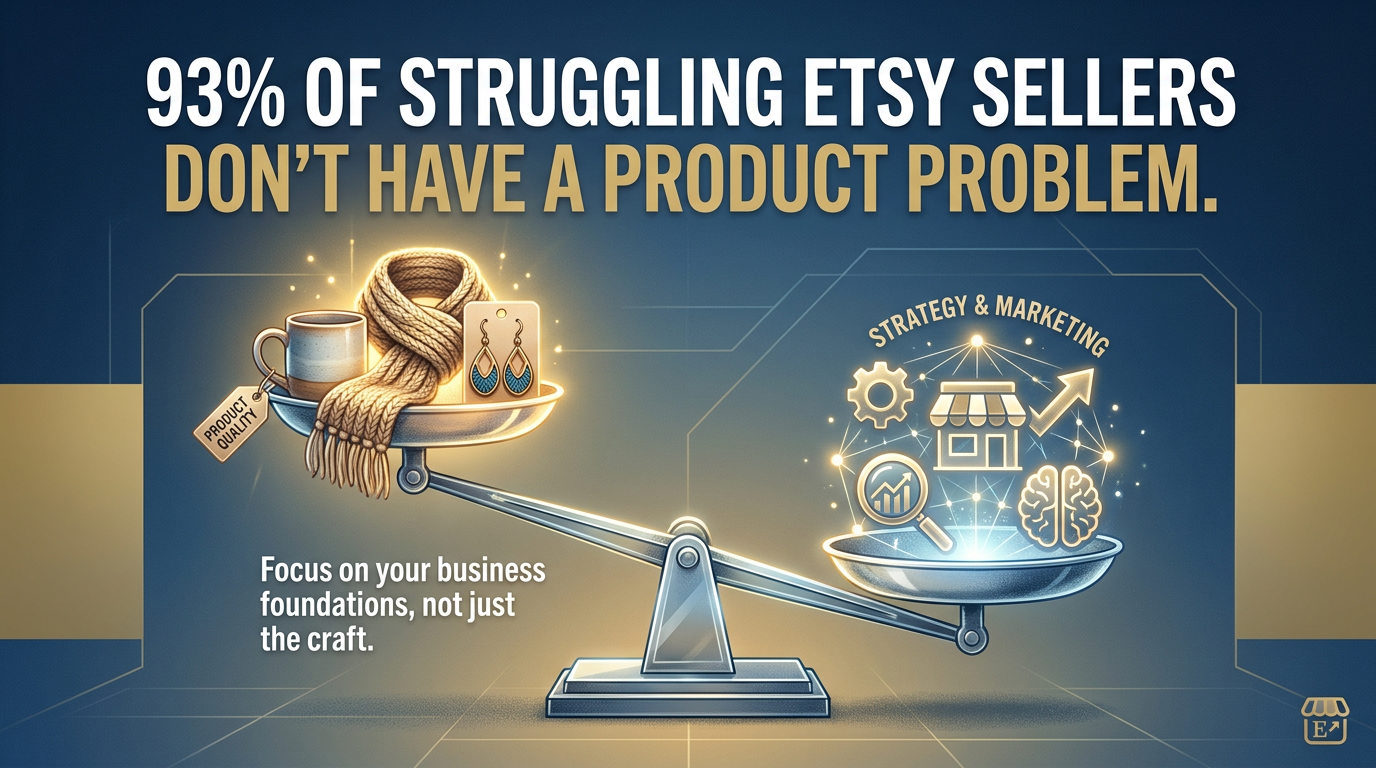
Most ETSY sellers who struggle with sales do not have a product problem. They have a listing problem. The difference between a shop that gets steady traffic and one that sits quietly with few views often comes down to avoidable mistakes in how listings are structured, written, and presented.
These mistakes are common because ETSY makes it easy to create a listing but does not teach you how to create a good one.
Titles That Describe Instead of Target
One of the most frequent mistakes is writing titles that describe the product from the seller's perspective rather than targeting what buyers actually search for. A title like "Beautiful Blue Handmade Scarf" tells ETSY's algorithm very little about what the product is in terms buyers use.
A stronger title leads with the primary search term and includes relevant descriptors: "Wool Scarf for Women — Handmade Blue Winter Scarf — Chunky Knit Gift." ETSY weights the first 40 characters most heavily, so the most important keyword should come first.
Avoid stuffing titles with repeated words or irrelevant terms. Each word should earn its place by matching something a buyer would actually type into the search bar.
Wasting Tags on Single Words
ETSY gives you 13 tags per listing, and each tag can be a multi-word phrase up to 20 characters. Many sellers waste tags on single generic words like "blue" or "gift" or "handmade" — terms that are too broad to rank for and too vague to match specific buyer intent.
Instead, use each tag as a distinct phrase that represents a different way someone might search for your product. If you sell a leather journal, your tags might include "leather notebook," "travel journal," "handmade diary," "personalized journal," and "gift for writer" — each one targeting a different search path.
Do not repeat words that are already in your title. ETSY combines title and tag keywords, so repeating them wastes tag slots.
Generic or Missing Descriptions
Many sellers treat the description as an afterthought — a few sentences copied from their title, or worse, left mostly blank. This is a missed opportunity for two reasons.
First, ETSY's algorithm now uses semantic understanding to evaluate listing relevance. A detailed, natural description that covers what the product is, how it is made, its dimensions, materials, and intended use gives the algorithm more context to work with.
Second, the description is where you answer buyer questions before they have to ask. What size is it? What material? How long does shipping take? Is it customizable? Buyers who find answers in the description are more likely to purchase. Buyers who do not find answers leave.
Poor Photography
This is arguably the highest-impact mistake. Your listing photo is the first thing a buyer sees in search results, and it directly affects your click-through rate — which in 2026 is one of the strongest signals ETSY's algorithm uses for ranking.
Common photography mistakes include cluttered backgrounds, inconsistent lighting, only showing one angle, using photos that do not accurately represent the product's size or color, and mixing styles across the shop so listings look like they come from different sellers.
You do not need professional equipment. A phone camera with natural lighting, a clean background, and consistent framing across all your listings will outperform expensive photography that lacks consistency.
Ignoring Shop-Level Signals
ETSY does not evaluate listings in isolation. Your shop's overall quality score affects how individual listings rank. Common shop-level mistakes include an incomplete About section, missing or vague shop policies, slow response time to customer messages, and inconsistent branding across listings.
Completing your About section, writing clear shipping and return policies, and responding to messages promptly are simple actions that strengthen your shop's standing in the algorithm.
Pricing Without Considering Shipping
ETSY has indicated that listings with shipping costs above $6 (for US domestic) may see reduced search visibility. Many sellers price their product low and then add high shipping — which hurts both their ranking and their conversion rate, since buyers often abandon purchases when unexpected shipping costs appear.
The better approach is to factor some or all of the shipping cost into the product price and offer free or reduced-rate shipping. This is not about absorbing costs — it is about presenting the price in a way that does not create friction at checkout.
Not Using All Available Listing Features
ETSY provides fields for attributes, materials, dimensions, variations, and more. Many sellers skip these. Each attribute you fill in gives ETSY more data to match your listing with relevant searches. A listing that specifies its material as "sterling silver" will appear in filtered searches for that material. A listing that leaves the field blank will not.
Use every relevant field. It costs nothing and expands your listing's reach.
Fixing These Mistakes
The encouraging part is that none of these mistakes require rebuilding your shop or investing in expensive tools. They require attention to detail, an understanding of how buyers search, and a willingness to revisit and improve existing listings rather than just adding new ones.
If your shop has dozens or hundreds of listings that need improvement, a structured approach — starting with your best-selling or highest-potential products — is more effective than trying to fix everything at once.
Learn about our ETSY Consulting services or contact us to discuss how we can help improve your listings.
Need help with this topic?
Intec Infosys can help you with practical solutions tailored to your business needs.
Contact Us